B2B SEO Best Practices for 2026: What Actually Drives Pipeline
B2B SEO best practices for 2026, built around pipeline instead of traffic. How B2B organic search differs from B2C, and the eight moves that get you found and chosen.
Your B2B SEO is working. Rankings are up, traffic is up, and the quarterly dashboard is green. And your VP of Sales can’t name a single deal that started with organic search.
That gap is the whole problem with how most B2B companies run SEO. You optimize for traffic. Pipeline is a different game, with different rules, and the playbook that wins it looks almost nothing like the one most agencies still hand you.
Here is what B2B SEO means in 2026, how it differs from the B2C version most advice is built on, and the eight best practices that move pipeline instead of just charts.
What Is B2B SEO?
B2B SEO is the practice of getting your site found by the people who buy on behalf of a company, not a household. You optimize your content, technical foundation, and authority so that buyers researching a business problem find you, trust you, and choose you. The goal is not traffic. It is qualified pipeline.
That last sentence is the part most teams skip, and it is why so much B2B organic search effort produces visitors who never become revenue.
How Is B2B SEO Different from B2C SEO?
B2B SEO differs from B2C in four ways that change everything about how you do it: longer sales cycles, buying committees instead of individuals, lower search volume at far higher deal value, and a mix of informational and commercial intent spread across several roles. Run the B2C playbook on a B2B site and you will rank for terms that never turn into revenue.
| B2C SEO | B2B SEO | |
|---|---|---|
| Buyer | One person, fast decision | Committee of 6 to 10, months-long decision |
| Search volume | High | Low, but high intent and high value |
| Intent | Mostly transactional | Informational plus commercial, by role |
| Win condition | Click and purchase | Qualified pipeline and closed revenue |
The buying committee is the difference that trips up most teams. Gartner puts the typical B2B buying group at 6 to 10 decision-makers, and those same buyers spend only about 17% of their journey meeting with potential suppliers. The rest is independent research. Your content is doing the selling whether you planned it that way or not.
The B2B SEO Best Practices That Actually Drive Pipeline
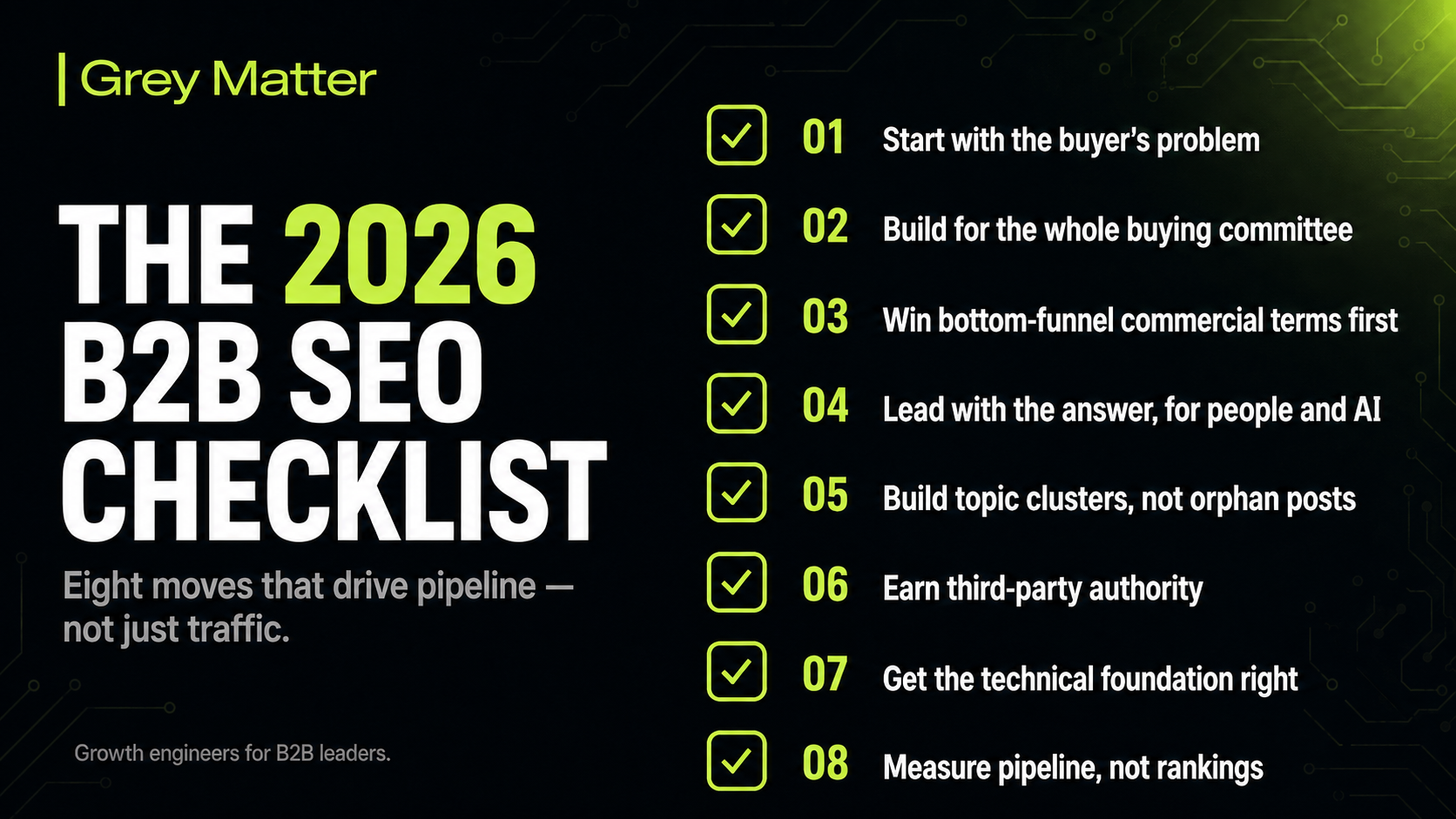
These are the eight moves that separate organic search that funds the business from organic search that just fills a report.
1. Start with the buyer’s problem, not the keyword
Keyword tools tell you what gets typed. They do not tell you what is worth ranking for. Map every target term to a specific buyer problem and a stage in the buying journey. A page built around “what causes premature bearing failure” earns a buyer with a budget. A page built around “industrial bearings” earns a student writing a report. Same category, opposite outcomes.
2. Build for the whole buying committee
With 6 to 10 people in the room, each one shows up with a different question. The technical evaluator wants specs. The economic buyer wants ROI. The end user wants to know it will not blow up their week. One page chasing one keyword cannot serve all three. Build a set of pages that answers each role’s question and links them together.
3. Win bottom-funnel commercial terms before head terms
Everyone wants to rank for the fat head keyword. It feels like progress. But “best [product] for [use case],” “[competitor] alternative,” and “[category] pricing” are the searches buyers run when they are close to a decision. Lower volume, far higher intent. Own those first. The head term can wait.
4. Lead with the answer so a person or a model can lift it
Buyers do not only use Google anymore. They ask ChatGPT, Perplexity, and Google’s AI Overviews, and all of them favor content that states a clear answer up front. Open the page with a direct 40-to-60-word answer, use question-shaped headers, and write claims as clean, standalone facts. The fundamentals here are not exotic. Google’s own May 2026 guidance is blunt that its AI features run on the same core SEO they always have. If you want to go deeper on this, our generative engine optimization guide covers the full framework for earning AI citations alongside traditional rankings.
5. Build topic clusters, not orphan posts
A single post ranks for a handful of terms and then stalls. A cluster — one pillar page plus a dozen supporting posts that link back to it — tells search engines you have real depth on a subject. Depth is what earns authority for the competitive terms. Pick the three or four problems you solve best and build a cluster around each. If you sell into a specific vertical, that includes dedicated pages for each industry you serve. Our SEO for manufacturers post shows what this looks like in a competitive industrial vertical.
6. Earn authority you do not own
Backlinks still matter, but the bigger signal in 2026 is corroboration: getting named in industry roundups, on review sites like G2 and Capterra, in trade press, and on podcasts. A claim that lives only on your own site is weaker than the same claim echoed in three places you do not control. This is the slowest lever and the one that compounds the hardest.
7. Get the technical foundation out of the way
None of the above matters if the engine cannot crawl, read, and load your site. Fast pages, a logical heading structure, clean internal links, and FAQ and article schema. Technical SEO will not win you the deal. Skipping it will quietly lose you the ranking before you ever get to compete.
8. Measure pipeline, not rankings
This is the practice that ties the other seven together. Rankings and traffic are inputs. The number that matters is how much qualified pipeline organic search creates and how much of it closes. If your SEO report still leads with keyword positions, you are measuring activity, not results. We wrote a full breakdown of why B2B SEO reporting is broken and what to measure instead. Read it before your next QBR.
B2B SEO Is the Largest Revenue Channel You Are Probably Underusing
Organic search is the single largest source of revenue for most B2B companies, driving close to 45% of it by one analysis. That is not a traffic stat. That is pipeline. And it is the channel most teams still report on with vanity metrics.
The reason the eight practices above work is that they match how buyers behave today. Gartner found that 61% of B2B buyers now prefer a rep-free buying experience. They want to research, compare, and shortlist on their own. The supplier whose content answers the real question, gets cited by the AI engines, and connects cleanly to pipeline is the one that makes the shortlist. The rest get found after the decision is mostly made.
Want to know exactly how visible you are when buyers ask AI tools about the problems you solve? Our B2B AI search visibility test walks you through a directional audit you can run yourself in an afternoon.
What This Costs You to Ignore
Every quarter you spend optimizing for traffic is a quarter your buyers spend shortlisting someone else. They are doing the bulk of their research before they ever contact you, and most of them would rather not contact you at all until they have to. The content they find during that research is your sales pitch.
You can keep counting rankings. Or you can build organic search that gets you found by the right committee, cited by the engines they trust, and credited with the pipeline it creates. The companies that own their category in 2026 will be the ones that made that switch. Whether yours is one of them is up to you.
Want to know if your organic search is driving pipeline or just traffic? Start with our breakdown of what to measure instead, put your own numbers against it, and find out where the real opportunity is hiding.
FAQ
What is B2B SEO?
B2B SEO is the practice of optimizing your content, technical foundation, and authority so businesses researching a problem find and choose your company. Unlike B2C SEO, the goal is qualified pipeline and closed revenue, not traffic or one-time transactions, because B2B purchases involve a buying committee and a months-long decision.
How is B2B SEO different from B2C SEO?
B2B SEO targets a buying committee of 6 to 10 people over a long sales cycle, while B2C targets one person making a fast decision. B2B keywords have lower volume but far higher intent and deal value, and B2B content has to serve informational and commercial intent across several roles, from technical evaluator to economic buyer.
What are the most important B2B SEO best practices in 2026?
Start with the buyer’s problem instead of the keyword, build content for the whole buying committee, win bottom-funnel commercial terms first, lead every page with a clear answer, build topic clusters, earn third-party authority, fix your technical foundation, and measure pipeline instead of rankings.
Does B2B SEO still matter now that buyers use AI search?
Yes, more than before. AI engines like ChatGPT, Perplexity, and Google AI Overviews pull their answers from web content, so the pages you optimize feed the AI responses your buyers read. Google has confirmed that optimizing for its AI features is still ordinary SEO — the same clear, well-structured, well-corroborated content that has always ranked. B2B organic search now means earning both the traditional ranking and the AI citation.
How long does B2B SEO take to drive pipeline?
Technical fixes and extractable answers can show up in search and AI results within weeks. Topic clusters and earned authority build over several months. Most B2B teams should plan on a 6-to-12-month horizon for organic search to become a reliable pipeline source, with early wins from bottom-funnel commercial terms along the way.
How do you measure B2B SEO success?
Measure the qualified pipeline organic search creates and how much of it closes, not keyword positions or raw traffic. Connect organic sessions to leads, opportunities, and revenue in your CRM. Rankings and traffic are inputs worth watching, but pipeline and closed revenue are the only numbers that prove B2B SEO is working.
Want a strategy built around this? Get a free B2B marketing diagnostic →