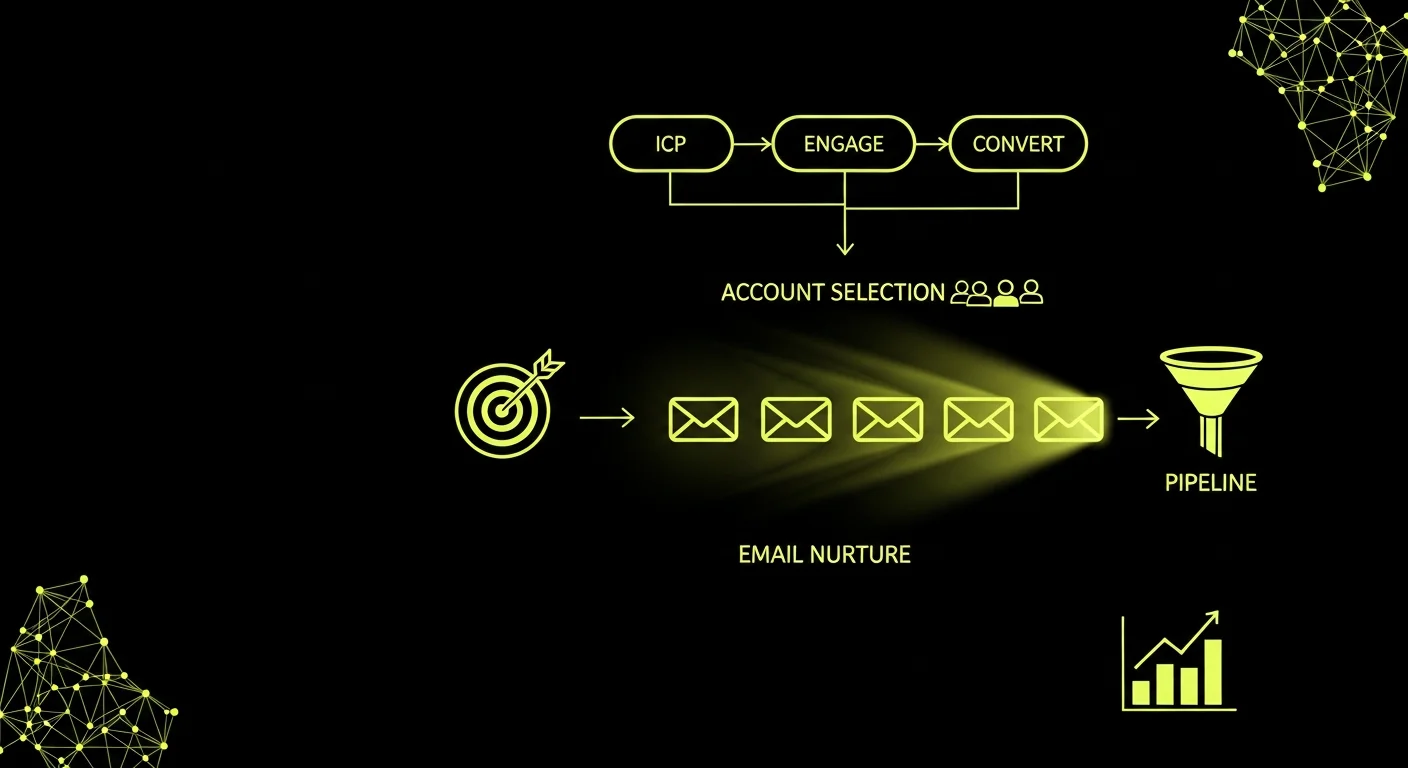
Stop marketing to everyone. Start marketing to the accounts that matter.
Target high-value accounts with orchestrated, multi-persona campaigns that drive real deal momentum.
Why ABM Works for Complex B2B
When your deal size is $50K+ and your buying committee has 6 to 10 people, spray-and-pray marketing doesn’t work. Your CFO doesn’t care about the same things your CTO cares about. Your Head of Compliance has totally different concerns from your VP of Sales. They aren’t one buyer. They’re six buyers, each with different priorities, different fears, and different information needs.
Traditional demand generation broadcasts the same message to everyone and hopes something sticks. ABM flips the funnel. Start with the accounts that matter most: the ones that align with your ICP and have genuine buying signals, then build programs around those specific accounts. Create messages for each stakeholder. Serve content that speaks to their role, their challenges, their priorities. The result is faster sales cycles, higher deal sizes, and deals that stick because the entire buying committee is already aligned with what you’re selling.
ABM isn’t faster. It’s smarter. And it’s dramatically more expensive per company if you do it wrong. But when you do it right, it’s the most efficient way to close complex deals. The difference between ABM done well and ABM done poorly is orchestration: email, LinkedIn, ads, website personalization, and content, all coordinated, all talking to the same accounts in the same language. Most companies can’t execute that. We can.
Our ABM Approach
Here’s how we build ABM programs that work:
Account Selection
ICP scoring, intent data, sales alignment. We identify which accounts are actually worth a sophisticated, expensive ABM program. Not every account deserves 1:1 treatment. We tier accounts by opportunity size and buying readiness. You get a tiered strategy: 1:1 ABM for the biggest deals (research-heavy, highly personalized), 1:Few ABM for mid-market targets (personalized but more efficient), and 1:Many ABM for larger audiences (scaled but still account-focused).
Buying Committee Mapping
For each account, we map the entire buying committee. Not just the sponsor or the primary champion, but everyone who influences, everyone who blocks, and everyone who needs to sign off. We research their titles, backgrounds, their likely concerns. A CTO’s biggest concern might be integration complexity. A CFO’s might be implementation cost. Once we understand the structure and priorities, we build messaging for each persona.
Personalized Content & Messaging
We create account-specific content. Not just generic blog posts that might apply to anyone. Case studies from companies in their vertical, competitive war stories that address their specific concerns, how-to guides that show how to solve their specific problem. CFO-focused content shows ROI and implementation timeline. Technical content for engineers dives into architecture and integration. When the CFO opens an email, it should feel like it was written for CFOs.
Multi-Channel Orchestration
Email isn’t enough. LinkedIn isn’t enough. Ads aren’t enough. The magic is orchestration: coordinating all these channels so your target account hears a consistent story across multiple touchpoints. Your CEO sees a LinkedIn article. Your CTO receives a technical white paper. Your CFO gets a targeted ad about ROI. Three different people, three different channels, one unified message.
Sales-Marketing Alignment
ABM fails when sales and marketing operate independently. Real alignment means shared goals, shared data, and shared accountability. Your ABM manager and your sales leader are checking in weekly, not quarterly. Sales tells marketing which accounts are moving and why. Marketing adjusts the program. We treat your sales team as co-owners of the strategy.
Measurement & Attribution
We track every touchpoint back to the account and back to pipeline. Which accounts are engaging most? Which personas are most responsive? Which channels drive actual meetings? We build dashboards that show account engagement over time, multi-touch attribution, and ABM-influenced revenue. Pipeline impact is what matters.
Frequently Asked Questions
Ready to target accounts that matter? Let’s build your ABM engine.
Get a free ABM assessment and see which accounts should be in your target list.